• Semiconductor Test & Spectroscopy Services
  • Classroom & Lab Raman Spectrometers
  • High-Sensitivity Raman Spectrometers
  • Request Quote
  • Terms & Policies

Helm Scientific


A Semiconductor Device and Chemical Analysis Laboratory


​Helm Scientific is committed to providing customers with high-quality, timely and professional services


E-mail: Device.lab@helmscientific.com

Please call by phone (714) 9646958 for credit card order and payment.


All spectral products sold by Helm Scientific are covered automatically by limited warrantee on condition that a purchased product is under correct operation, handling and maintenance and without any tampering or modification. The limited warrantee includes (1) two-year warrantee of CCD spectrometer by OEM, (2) one-year warrantee of the optical and mechanical parts of sample optical chamber and stage, and (3) one-year warrantee of unopened laser unit. Lifetime technical support via email is provided.


Custom Raman & Luminescence Spectrometer For Semiconductors, Thin-Films, Chemicals & Reaction Kinetics


Price: Please email (device.lab@helmscientific.com) for detail and quote.
Accept credit cards via phone and electronic fund transfer (EFT), ACH or check.


The images above illustrate a newly-developed low-cost, high-performance Raman/Photoluminescence system (Image 1) and samples under analysis. The system consists of a 532 nm/200 mW laser unit for Raman/photoluminescence excitation, a XYZ positioning sample/wafer stage, a Raman probe, a special proprietary spectrometer optimized for an advanced TEC-cooled high-sensitivity imager camera. In Image 2, Raman signal from a 4-inch Si(100) wafer is detected through an objective lens and with a 45o laser incident angle. Image 3 shows the Raman spectral measurement of isopropyl alcohol (91% IPA) in a 2-mL standard glass vial with an orthogonal green laser excitation. Image 4 shows an acetaminophen tablet during Raman spectral scan.


The system is specifically designed for semiconductor thin-film process professionals and research scientists to measure Raman and photoluminescence spectra of silicon & III-V wafers/devices, thin films and coatings, chemicals in aqueous and organic solvents, liquids/fluids or solid samples under 532 nm laser excitation. In addition, it can test samples on glass slides or 96-well micro plates for chemical, biological and surface-enhanced Raman scattering (SERS) analyses. The system can be reconfigured with a 405 nm purple laser and a wide range spectrometer for photoluminescence (PL) measurement covering the entire visible wavelength range. Electroluminescence (EL) measurement of light emitting devices can be carried out with electrical probes and instruments. Its main applications include 1) silicon, III-V semiconductors and transition metal chalcogenide 2D materials, 2) chemical, biochemical, and pharmaceutical analysis, and 3) chemical reaction kinetics and mechanisms. Its main Raman spectral features are:

  • Advanced TEC deeply-cooled imager camera (>10 M pixels)
  • High signal-to-noise ratio (SNR>1000)
  • Long hardware integration time (up to 2000 sec) for extremely weak Raman scattered light detection
  • Wide Raman shift range: 180 ~ 4400 cm-1 (1200 lines/mm grating, standard) or 180 ~ 3200 cm-1 (1800 lines/mm grating)
  • Spectral resolution: 5.5 and 11.4 cm-1 FWHMs for diamond 1338 cm-1 Raman peak with 0.1 and 0.3 nm laser linewidths, respectively
  • High data sample resolution: ~1 data point/cm-1
  • Superb noise suppression by averaging up to 2800 pixel signals at each spectral point
  • Computerized camera control, spectrograph image acquisition, image-to-spectrum extraction
  • Long-pass filter rejects 99.9999% laser at 532 nm
  • Switchable 90o orthogonal and 45o back-scattering Raman detection with respect to laser beam
  • High detection sensitivity or lower detection limit (LDL)
  • Custom-made system catered for various experiments, including 785 nm laser excitation


Applications of High Sensitivity Laser Raman Spectrograph


Helm Scientific’s low-cost Raman spectrograph is specifically designed to measure Raman and photoluminescence spectra of semiconductor wafers, thin films and coatings, dilute aqueous and organic solutions of inorganic and organic compounds, liquids/fluids or solid samples under 532 nm laser excitation. In addition, it can test samples on glass slides for chemical, biological and surface-enhanced Raman scattering (SERS) analyses. The following Raman spectra demonstrate our new Raman spectrometer's capabilities of ultra high sensitivity and superb signal-to-noise ratio (SNR).

  1. Silicon single crystal wafer, i.e. Si(100)
  2. Diamond crystals in abrasive coating on metal
  3. Graphite in a pencil core
  4. High-density polyethylene (HDPE, i.e. -(CH2-CH2-)n)
  5. Concentrated isopropyl alcohol (91% CH3CH(OH)CH3)
  6. Diluted isopropyl alcohol (0.86% CH3CH(OH)CH3)
  7. Dilute acetic acid (5% CH3COOH)
  8. Dilute aqueous solution of hydrogen peroxide (3% H2O2)
  9. Dilute aqueous solution of sodium hypochlorite (7.55% NaOCl)
  10. In situ real-time monitoring of NaOCl + CH3CH(OH)CH3 Redox Reaction

Spectra 1, 5, 6, 8 and 9 herein are raw or original without any data smoothing or baseline correction.


Please email or call us (device.lab@helmscientific.com) for detail and quote.


1. Raman Spectroscopy of Si(100) Single Crystal Wafer


The Raman spectrum of a small piece of single crystal Si(100) wafer is illustrated below. The narrow Raman peak of transverse optical (TO) phonon at ~520 cm-1 has been widely used in semiconductor industry to evaluate silicon stress and morphology for IC engineering and manufacturing. For example, depending on growth conditions, SiO2 and SiNx:H thin films may cause tensile or compressive stress to Si substrate, shifting this Raman peak position. Polycrystalline Si shows a Raman peak at ~515 cm-1 while nanocrystalline Si at ~502 cm-1. Amorphous Si exhibits a broad Raman peak around ~480 cm-1. Raman spectroscopy is also routinely used to study III-V (e.g. GaN), transition metal chalcogenide 2D thin film materials and devices.


2. Raman Spectrum of Diamond Crystal in An Abrasive Coating on Metal


The high-sensitivity Raman spectrum of a diamond coating on a metal file shows a single characteristic narrow peak at 1327 cm-1 and a very weak peak around 1450 cm-1 in the plot below. The former originates from diamond polycrystals and the latter may originate from trans-polyacetylene in grain boundaries. The absence of D and G bands associated with amorphous carbon in the spectrum indicates the high crystallinity of the diamond coating. Diamond CVD process engineers/scientists have used Raman spectroscopy to optimize the growth conditions of artificial diamonds or films for various industrial applications. In particular, diamond is an ultra-wide band gap (UWBG) semiconductor material and exhibits high dielectric breakdown voltage, high thermal conductivity and high electron and hole mobilities. These superb properties enable diamond based transistors and diodes to operate at temperatures near 300oC as semiconductor power devices.


3. Raman Spectrum of Graphite


The Raman spectrum of graphite is obtained by focusing a 532 nm green laser beam at 45o incident angle on a pencil core (see insert). Three Raman peaks exist in the spectrum. The dominant peak at 1577 cm-1 is the well-known G band originating from the layered hexagonal networks of sp2 hybridized carbon atoms, i.e. typical graphite structures. The peak at 1341 cm-1 is associated with graphite defects (D band), i.e. sp3 hybridized carbon atoms. The intensity ratio of the two bands have been used to quantify the crystallinity of the graphite materials. The peak at 2714 cm-1 is labelled as 2D band, originating from the second harmonic of the D band. The 2D band to G band intensity ratio is an important measure of the number of layers in graphene materials. In addition, it is reported that single layer graphene exhibits a red-shifted 2D Raman peak near 2640 cm-1 from the G band of graphite. In comparison, diamond shows a single Raman peak at 1332 cm-1 because of the dominant sp3 hybridization of carbon bonding.


4. Raman Spectrum of High-Density Polyethylene (HDPE) Plastic


The image below shows a Raman spectrum of high-density polyethylene (HDPE, i.e. -(CH2-CH2-)n) from the newly developed Raman spectrograph system. The Raman peaks at 2872, 2841, 1427, 1281, 1114 and 1048 cm-1 originate from the CH2 asymmetric and symmetric stretching vibrational modes, CH2 bending and twisting vibrational modes, and C-C bond stretching modes, respectively.


5. Raman Spectrograph and Spectrum of 91% Isopropyl Alcohol (CH3-CH(OH)-CH3)


Raman spectral measurement with a Helm Scientific's spectrograph is like taking a photograph. The image below is the spectrograph of 91% isopropyl alcohol from which a high-quality Raman spectrum is extracted by calibrating image pixel horizontal position into Raman shift and averaging pixel gray values in the vertical pixel direction. A 1800 grooves/mm grating was used to acquire this spectrum.


6. Raman Spectrum of 0.86% Isopropyl Alcohol (CH3-CH(OH)-CH3)


Chemical and biochemical reactions in aqueous solutions are the foundation of all lives on the earth and can be monitored and studied via Raman spectroscopy. A major challenge to detect the low-concentration solutes in water solvent using Raman spectrometers is analytic sensitivity or signal-to-noise ratio. By using a cooled image sensor, an improvement in detection sensitivity by a factor of >100 has been achieved. Below is the Raman spectrum of 0.86% isopropyl alcohol (CH3-CH(OH)-CH3). In addition to the symmetric O-H stretching, asymmetric O-H stretching and H-O-H bending vibrational Raman peaks of water molecules, the C-C stretching, C-O stretching, CH3 bending, CH3 and C-H stretching peaks of isopropyl alcohol molecules are clearly identifiable in the spectrum. The lower detection limit (LDL) of aqueous IPA solution is estimated to be ~0.5% when using the Raman peak at ~816 cm-1. One application of the system is to study the kinetics and mechanisms of chemical and biochemical reactions in water solution and other liquids/fluids.


7. Raman Spectrum of 5% Acetic Acid (CH3-COOH)


The Raman spectrum of water diluted acetic acid (5%) is dominated by asymmetric (3448 cm-1) and symmetric (3275 cm-1) H-O-H stretching bands broadened by inter-molecular hydrogen bonding, and H-O-H bending peak at 1660 cm-1. The C-H stretching, C=O stretching and C-C stretching bands of acetic acid appear at 2958, 1695 and 906 cm-1, respectively. The Raman peak at 1695 cm-1 originates from C=O stretching vibration of hydroxylic -COOH group and has been extensively studied to reveal hydrogen bonding between acetic acid monomers to yield a cyclic dimers, between water molecules and acetic acid molecules. Dilution of liquid acetic acid with water results in a shift of the C=O stretching vibration band from 1665 to 1715 cm-1 (J. Phys. Chem. A 1999, 103, 50, 10851–10858).


8. Raman Spectrum of 3% Hydrogen Peroxide (H2O2)


The Raman spectrum of water diluted hydrogen peroxide (H2O2, 3%) shows a peak at 876 cm-1 originating from the O-O stretching vibrational mode of H-O-O-H molecules. The spectrum is dominated by the peaks of H2O molecules, including asymmetric and symmetric O-H stretching vibration bands around 3450 and 3250 cm-1, and H-O-H bending band at 1635 cm-1. The lower detection limit (LDL) of H2O2 can be estimated to be <0.5%. This spectrum is acquired with a 1200 grooves/mm grating so as to have a wider Raman spectral range.


9. Raman Spectrum of 7.55% Aqueous Solution of Sodium Hypochlorite (NaOCl)


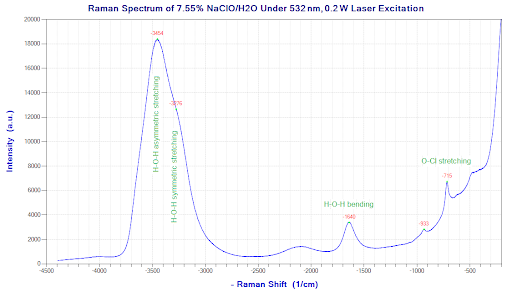
Sodium hypochlorite (NaOCl) solution is widely used as a household bleaching agent or disinfectant. For example, Clorox Performance Bleach contains 7.55% sodium hypochlorite and 92.45% "OTHER INGREDIENTS" per its label. Helm Scientific's Raman spectrograph can easily detect the low concentration of hypochlorite anions, i.e. OCl- as shown in the spectrum below. Clearly, vibrational Raman peaks characteristic of water molecule (H2O) dominate the spectrum, with the Raman shifts of asymmetric O-H stretching, symmetric O-H stretching and H-O-H bending modes being located at 3454, 3276 and 1640 cm-1, respectively. The small Raman peak at 715 cm-1 originates from the stretching vibration of hypochlorite (OCl-) anions according to published papers. The O-Cl bond length is ~1.7 A while that of O-H is ~0.96 A with a H-O-H bond angle of ~104 degrees. The lower detection limit (LDL) of NaOCl is about ~0.2% based on experiment.


10. In Situ Real-Time Raman Spectral Monitoring of NaOCl + CH3CH(OH)CH3 Redox Reaction


Our Raman spectrograph's high sensitivity makes it suitable for in situ real-time investigation of chemical reaction kinetics and mechanisms in both aqueous and organic solvents. After mixing ~1.5 mL 7.55% sodium hypochlorite (NaOCl) aqueous solution with ~0.5 mL 91% IPA in a 2 mL standard glass vial at room temperature, the reduction of OCl- anions by CH3CH(OH)CH3 molecules was monitored in situ in real-time for 33 minutes by scanning 16 high-quality Raman spectrographs from which 16 Raman spectra were extracted and plotted below. The time origin (t=0 s) of the plot is the time when the first Raman spectrograph acquisition was initiated. The concentrations of NaOCl and IPA immediately after mixing were ~5.7% and ~22.3%, respectively. It is estimated that ~36% NaOCl had reacted with IPA when the first spectrograph acquisition started. Despite the presence of the dominant Raman scattering bands associated with relatively high IPA and H2O concentrations, the Raman spectral band at 720 cm-1 reveals the real-time hypochlorite anion concentration (i.e. [OCl-], see peaks in a red rectangle and their zoom-in insert) as OCl- anions oxidize IPA reductant. The Raman band at 720 cm-1 originates from the stretching vibration of hypochlorite (OCl-) anions according to published papers. By integrating their peak areas between 680 and 760 cm-1 for all 16 spectra, the concentration of [OCl-] as a function of reaction time has been plotted as well. Obviously, kinetic rate equation containing redox reaction orders, activation energy and pre-exponential factor can be obtained by more quantitative experiments at various temperatures.


Helm Scientific
Laboratory: 1680 Toronto Way, Costa Mesa, California 91626, U. S. A
Headquarter: Fountain Valley, CA 92708, U. S. A.
E-mail: Device.Lab@HelmScientific.com
Phone: (714) 9646958